
In India, small businesses play a crucial role in economic growth, employment generation, and innovation. To support these enterprises, the Government of India introduced the concept of MSME registration. Over time, this system evolved into what is now known as Udyam Registration.
Many business owners are still confused about the difference between Udyam Registration and MSME Registration. Are they the same? Has one replaced the other? Which one should you apply for?
This detailed guide will clarify everything in a simple and easy-to-understand way.
MSME stands for Micro, Small, and Medium Enterprises. Earlier, businesses had to register under MSME through a system known as Udyog Aadhaar Memorandum (UAM).
This registration was introduced to:
Provide recognition to small businesses
Offer government benefits and subsidies
Help businesses access loans easily
However, the MSME registration system had certain limitations, such as manual verification and lack of transparency.
Udyam Registration is the new and improved version of MSME registration, launched by the Government of India on 1 July 2020.
It is a fully online, paperless, and Aadhaar-based registration system designed to simplify the process for entrepreneurs.
Key highlights:
Completely digital process
No paperwork required
Instant registration
Integration with PAN and GST databases
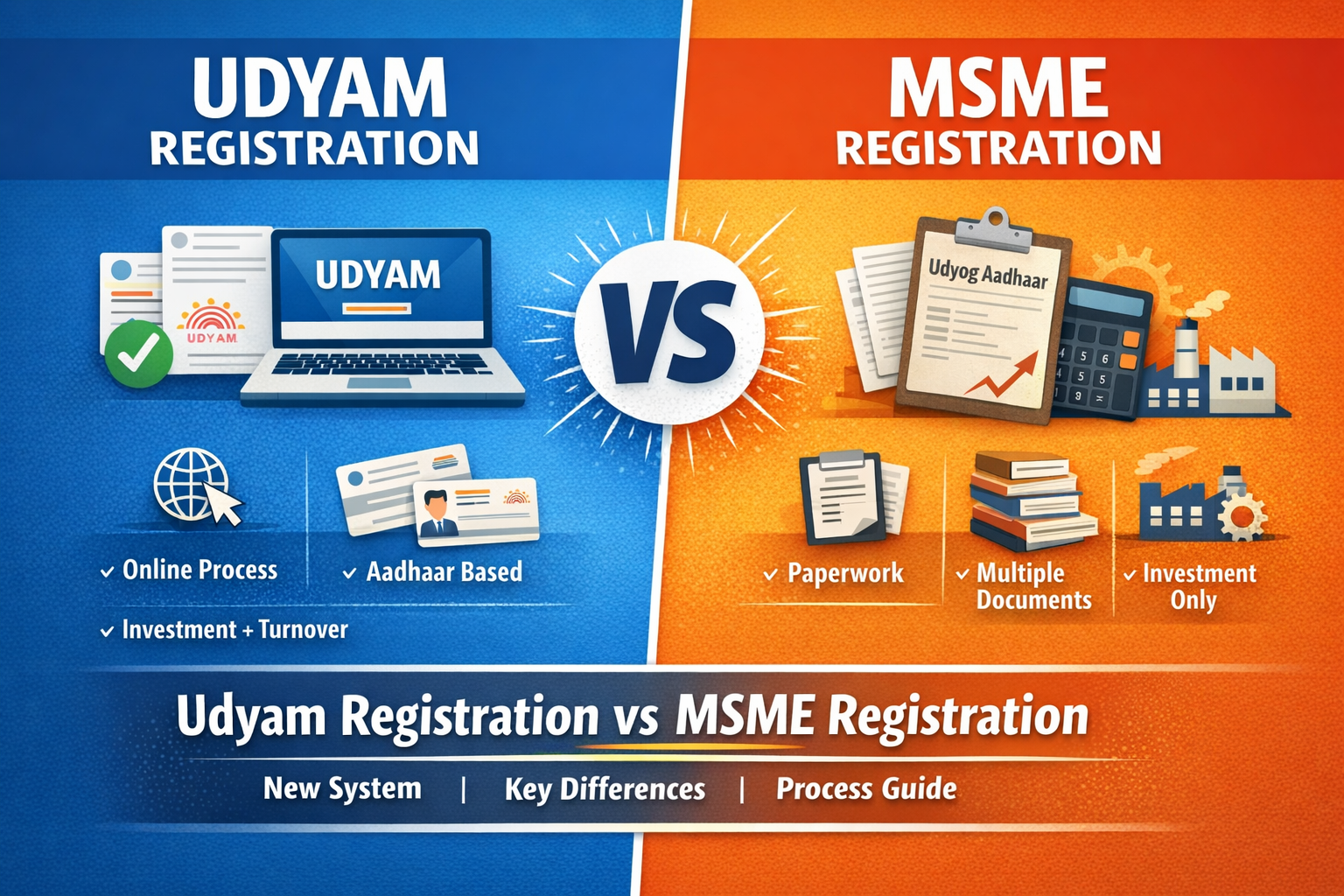
MSME Registration (Old): Based on Udyog Aadhaar system
Udyam Registration (New): Fully automated and online system
Udyam has replaced the old MSME registration system.
MSME: Semi-manual and less structured
Udyam: Fully digital, simple, and user-friendly
MSME: Required multiple documents
Udyam: Requires only Aadhaar and basic business details
MSME: Limited verification system
Udyam: Linked with Income Tax and GST for real-time verification
MSME (Old): Based only on investment in plant and machinery
Udyam (New): Based on both:
Investment
Annual turnover
MSME: Difficult to update
Udyam: Easy online updates anytime
MSME: Needed renewal in some cases
Udyam: Lifetime validity (no renewal required)
|
Feature |
MSME Registration (Old) |
Udyam Registration (New) |
|---|---|---|
|
System |
Udyog Aadhaar |
Online Automated Portal |
|
Process |
Semi-manual |
Fully digital |
|
Documents |
Multiple |
Aadhaar-based |
|
Verification |
Limited |
PAN & GST linked |
|
Criteria |
Investment only |
Investment + Turnover |
|
Validity |
Limited |
Lifetime |
The government introduced Udyam Registration to:
Eliminate paperwork
Improve transparency
Enable faster processing
Reduce fraud and duplication
Provide better access to government schemes
Businesses registered under Udyam can enjoy several advantages:
Easy access to bank loans at lower interest rates
Eligibility for government subsidies and schemes
Protection against delayed payments
Preference in government tenders
Easier approval for licenses and registrations
Any business falling under the MSME category should apply, including:
Proprietorship firms
Partnership firms
Private limited companies
LLPs
Startups and small manufacturers
Yes, but only for businesses registered before July 2020. However, the government has advised all existing MSMEs to migrate to the Udyam Registration system.
Without migration, businesses may not be able to access updated benefits.
The migration process is simple:
Visit the Udyam Registration portal
Enter your Udyog Aadhaar number
Verify using OTP
Fill updated details
Submit the application
Entering incorrect Aadhaar details
Using mismatched PAN information
Not updating GST details
Applying multiple times for the same business
Understanding the difference between Udyam Registration and MSME Registration is essential for every small business owner in India. While MSME registration was the earlier system, it has now been completely replaced by Udyam Registration.
The new system is faster, more transparent, and easier to use, making it highly beneficial for modern businesses. If you are still registered under the old MSME system, it is strongly recommended to migrate to Udyam Registration to continue enjoying government benefits.
1. What is the main difference between Udyam Registration and MSME Registration?
The main difference is that MSME Registration is the old system, while Udyam Registration is the new, fully online and updated system introduced by the Government of India.
2. Is MSME Registration still valid in India?
Yes, MSME Registration (Udyog Aadhaar) is still valid for older businesses, but it is recommended to migrate to Udyam Registration to continue receiving benefits.
3. Has Udyam Registration replaced MSME Registration?
Yes, Udyam Registration has officially replaced the old MSME registration system from July 1, 2020.
4. Is Udyam Registration free of cost?
Yes, Udyam Registration is completely free on the official government portal. No registration fee is required.
5. Who is eligible for Udyam Registration?
Any micro, small, or medium enterprise including proprietorships, partnerships, LLPs, and private limited companies can apply.
6. What documents are required for Udyam Registration?
Only Aadhaar number, PAN details, and basic business information are required. No physical documents need to be uploaded.
7. Can I update my Udyam Registration details later?
Yes, Udyam Registration allows easy online updates for business details anytime.
8. What are the benefits of Udyam Registration?
Benefits include easier access to loans, subsidies, government schemes, and protection against delayed payments.
9. Do I need GST for Udyam Registration?
GST is required only if your business is liable to be registered under GST laws; otherwise, it is not mandatory.
10. How long does it take to get the Udyam certificate?
Udyam Registration is instant, and the certificate is usually generated immediately after successful submission.
We value your feedback! Help others by leaving a quick Google review.
Write a Review on Google